What a Place Name Can Preserve, and What It Cannot
Learn how to read a place name as a clue to local language, landscape, or memory without mistaking it for a complete account of the past.
A place name can preserve a sound, a landscape clue, or a memory long after the people who supplied it have gone. Reading a place name well means asking what the name actually supports—and resisting the urge to turn a suggestive word into a complete history of the location.
A name is evidence, but not a full record
Names travel farther through time than explanations do. A label on a road sign or county map may have been handed down across generations, while the circumstances that produced it remain uncertain. That makes the name valuable, but incomplete: it can direct attention toward a question without settling the answer.
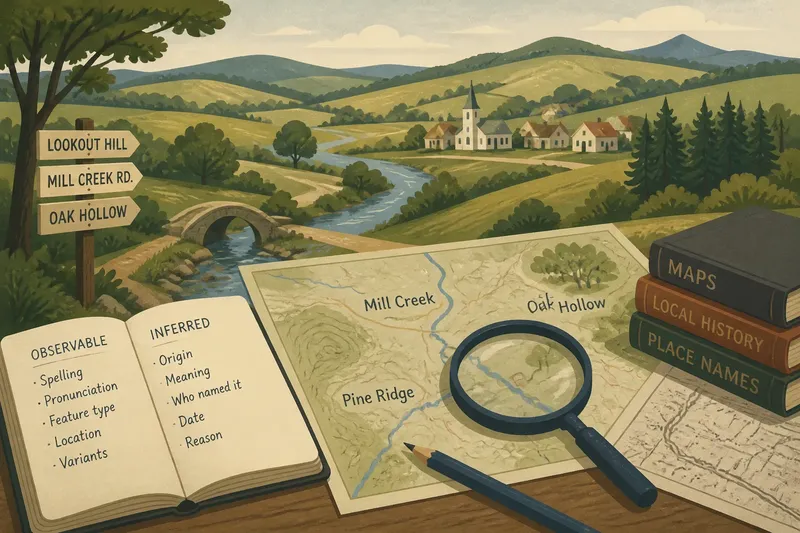
Start by separating what is observable from what is inferred. You can observe the spelling on a current map, hear how residents pronounce it, and note whether the same name appears on a creek, ridge, road, or settlement. You cannot infer from the word alone who first used it, when it entered local speech, or whether its meaning has stayed constant.
This distinction matters especially with familiar-looking English words. A name such as “Oak Hollow” might describe trees and terrain, but it might also have been assigned later, borrowed from another place, or retained after the landscape changed. The name provides a lead; other evidence must do the explaining.
Read the name in layers
A careful reading begins with the form of the name, then moves outward to its use and setting. These layers help prevent a neat-looking interpretation from taking over the evidence.
- Current form: Record the spelling and pronunciation used on maps and locally. A spelling may conceal older sounds, while local pronunciation can preserve a form absent from the printed version.
- Possible language: Ask whether the name appears to come from English, another language, a family name, or a word whose origin is disputed. Similar sounds do not establish a shared source.
- Named feature: Identify what the name labels now. A name attached to a creek, road, settlement, and postal area may have different histories in each use.
- Physical setting: Look for a plausible connection to a visible feature such as a bend, wooded slope, spring, or exposed rock. Treat the match as a clue, not proof that the feature inspired the name.
- Local memory: Notice stories residents associate with the name, while distinguishing remembered tradition from documented origin. Both can matter, but they answer different questions.
Keep each layer in its own column when making notes. A plausible interpretation becomes easier to judge when its supporting observations are visible beside it.
Place names preserve different kinds of information
Some names describe a feature. A word referring to a ford, mill, or wooded area may preserve a practical relationship between people and a landscape, even if the feature has since disappeared. In other cases, a name carries the mark of a language or naming tradition that was once used in the region. The word may outlast the speech community that introduced it.
Other names point toward settlement or ownership. A family name attached to a road or locality can suggest an association, but it does not by itself establish who lived there, how long they held land, or how the name came to be adopted. A name can also honor a person or institution without recording the full circumstances of that choice.
Names may preserve an older boundary or administrative connection, too. A locality can keep a county, parish, or township label after the relevant jurisdictions have changed. In that case, the name offers evidence of inherited usage, not necessarily a precise map of an earlier boundary.
Say you find “Mill Creek” on a county map, but no mill appears beside the water today. The name reasonably directs you to ask whether a mill once stood there and whether local records or older maps support that possibility. It does not establish the mill’s location, operator, date, or role in the surrounding community.
Why a convincing origin story may still be wrong
People naturally look for a tidy match between a word and its surroundings. A steep place called “Lookout” seems to explain itself; a settlement named for a family seems to identify its founders. But place names can be transferred, shortened, respelled, or applied to a different feature from the one first named. A familiar word may also be a later reinterpretation of an older, less familiar sound.
Spelling is particularly easy to overread. Mapmakers and record keepers may have written down a name as they heard it, and later copies can carry those choices forward. A modern spelling can therefore look like a clear description even where its older form had a different sound or meaning. Comparing variants can reveal uncertainty rather than remove it.
One story repeated in local conversation may preserve a genuine tradition, but repetition alone does not tell you whether it is an origin account, a later explanation, or a story attached to a name after the fact. Describe it as local tradition unless independent evidence supports a stronger claim.
What should you check before accepting an origin?
Does the name appear on older maps?
Compare maps from different periods and note changes in spelling, location, and the feature being named. A first appearance can narrow the record you need to examine, but it does not prove that the name began at that moment.
Does the name fit the land?
Check whether the proposed meaning matches a feature visible on the ground or on a reliable map. A match can make an interpretation plausible, while a mismatch may suggest that the feature changed or that the name came from elsewhere.
Are there competing explanations?
Look for alternative language origins, family associations, and local traditions rather than choosing the most appealing account immediately. If the evidence remains divided, describe the possibilities as uncertain instead of forcing a single answer.
What exactly does the name label?
Confirm whether the name belongs to a settlement, watercourse, road, or broader area, since one label may shift across nearby features. This prevents a fact about one named feature from being treated as the history of an entire place.
Keep the conclusion narrower than the clue
When writing or talking about a place name, use language that matches the strength of the evidence. “The name may refer to a former mill” leaves room for an unconfirmed explanation. “The name records the mill that founded the community” makes several additional claims that need support.
A useful account identifies the clue, names the uncertainty, and points to what could clarify it: older maps, local records, language knowledge, or accounts tied to the place. If those sources do not resolve the origin, that is a meaningful result. The name can still show how people have remembered or described the location, even when its first meaning remains unknown.
For anyone tracing a county’s place names, the sound of a word is a starting point, not a verdict. The most responsible interpretation preserves both what the name suggests and what the surviving evidence cannot yet say.